
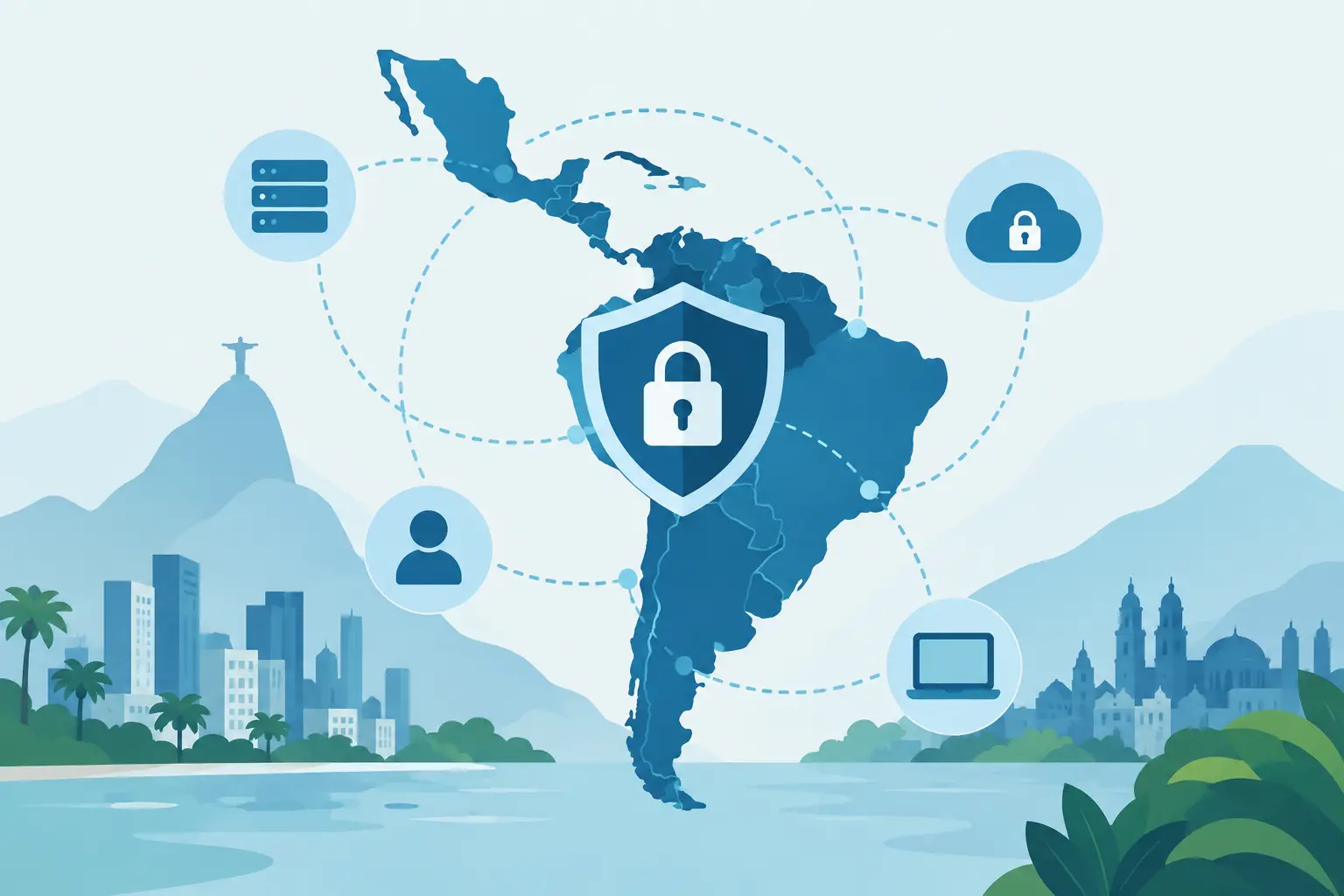
A regional rollout can create a data protection issue before the first local employee is hired. A U.S. company may centralize HR records in one system, use a global CRM, engage a payroll provider in another country, and support customers from a contact center in Latin America. Each operational choice can trigger different obligations around collection, notice, security, retention, vendor management, and international transfers.
For companies expanding in the region, cross border data protection is not a standalone compliance exercise. It is part of how the business hires, sells, contracts with vendors, responds to incidents, and manages information across borders. The objective is not to force every country into one identical model. It is to establish a workable regional standard while identifying the local requirements that require a different approach.
Why regional data protection planning cannot be one-size-fits-all
Latin America does not operate under a single privacy regime. Several jurisdictions have comprehensive data protection laws, while others rely on more limited or sector-specific rules. Even countries whose laws share familiar concepts, such as consent, purpose limitation, data subject rights, and security safeguards, can apply them differently in practice.
For example, the legal basis for processing employee information, the content of a privacy notice, registration or filing expectations, and the formalities for sharing information with a service provider can vary by jurisdiction. A policy developed solely for the United States or Europe may be a useful starting point, but it is rarely a complete answer for operations spanning Mexico, Central America, Panama, Colombia, and the Dominican Republic.
The commercial risk is equally regional. A fragmented approach can delay onboarding, complicate a due diligence process, create inconsistent employee communications, and make incident response slower when multiple teams must determine who owns the data and which rules apply. Central coordination matters because the business must make decisions across the entire data lifecycle, not just approve a transfer agreement after the fact.
Cross border data protection starts with the business flow
The first question is not, “Where is the server?” It is, “How does information move through the business?” Companies should map the real operating flow of personal data, including data relating to employees, candidates, customers, suppliers, website visitors, and business contacts.
This mapping should identify what information is collected, why it is used, who can access it, where it is stored, and where it is disclosed. It should also capture less obvious flows. A regional manager accessing personnel files from another country, a U.S. parent reviewing local performance data, or a software vendor providing remote support may each involve cross-border access even if the information remains hosted in a single cloud environment.
For a growing company, the most useful map is practical rather than theoretical. It should connect each data flow to an owner in HR, IT, operations, finance, or legal. That makes it possible to identify high-priority flows, such as payroll administration, recruiting platforms, customer support systems, background checks, and cross-border reporting to headquarters.
Employment data deserves early attention
Workforce data is often the first significant category of personal information processed in a new market. It may include identification documents, compensation records, bank details, health-related accommodations, immigration records, emergency contacts, and performance information. Some of this information may be sensitive under local law or require heightened safeguards.
The employment context also requires care when considering consent. An employee may sign a consent form, but the validity and usefulness of that consent can be limited where there is an imbalance of power. Depending on the jurisdiction and the processing purpose, an employer may need to rely on legal, contractual, employment-related, or legitimate business grounds instead, while still providing a clear notice.
This is especially relevant for companies using regional HR platforms. The platform may be commercially efficient, but its implementation should be reviewed against local requirements for notices, access controls, retention periods, international access, and the handling of sensitive records. The same analysis applies when engaging an employer of record, payroll processor, recruiting firm, or benefits administrator.
Build a transfer framework that reflects local requirements
An international data transfer is often treated as a contract problem. Contracts matter, but they are only one component. A legally sound transfer framework usually combines local legal analysis, transparency to affected individuals, vendor controls, information security, and internal accountability.
The right structure depends on the jurisdictions involved and the role of each party. Is the local entity deciding why and how the data will be processed? Is the U.S. parent receiving data for centralized management? Is a third-party provider acting only on instructions, or using information for its own purposes? These distinctions affect the documentation and governance needed.
A regional program commonly includes appropriate privacy notices, data processing provisions with vendors and affiliates, confidentiality obligations, security requirements, procedures for responding to rights requests, and a process for approving new transfers. In certain jurisdictions, additional formalities, authorizations, registrations, or transfer-specific conditions may apply. The answer should be confirmed locally rather than assumed from a regional policy.
Security should also be addressed in operational terms. A contractual commitment to protect data has little value if accounts are shared, access rights are not reviewed, files are sent through unapproved channels, or a local team does not know whom to contact after a suspected incident. The controls should match the data and the business. A payroll file and a marketing contact list do not carry the same level of risk, even though both contain personal information.
Vendor management is where many gaps appear
A company may have strong internal policies and still lose visibility once data enters its vendor ecosystem. Regional operations frequently rely on local providers for payroll, benefits, recruitment, call center services, document storage, security, transportation, and customer support. Those providers may use their own platforms or subcontractors, creating additional layers of access.
Before onboarding a provider, businesses should determine what data the provider needs, whether it will transfer or host that data outside the country, how long it will retain the data, and how it will support incident response and individual rights requests. These questions are not intended to slow procurement. They allow legal, procurement, and operational teams to select a model that can be managed after the contract is signed.
Vendor terms should be proportionate. A small local service provider may not be able to negotiate the same technical commitments as a global cloud provider. Yet minimum expectations remain necessary: use data only for authorized purposes, restrict access, maintain appropriate security measures, report incidents promptly, assist with compliance obligations, and return or securely dispose of data when the engagement ends.
Prepare for rights requests and incidents before pressure builds
Privacy compliance becomes real when an employee asks for access to a file, a customer wants information corrected, or a vendor reports a security event on a Friday afternoon. A regional organization needs a clear escalation path, not just a policy stored in a shared folder.
For rights requests, the local HR or customer-facing team should know how to recognize a request and where to send it. The central legal or privacy function should then coordinate the response with local counsel, the relevant business owner, and the system administrator. This avoids two common problems: missing local deadlines and disclosing information that involves other individuals or protected business records.
Incident readiness requires the same discipline. Companies should establish who investigates, who preserves evidence, who communicates with affected individuals and authorities when required, and who can make decisions outside normal business hours. Notification duties and timelines may vary by country and by the nature of the incident. A uniform global incident playbook is valuable, but it needs local decision points.
Create regional consistency without ignoring local law
The most effective model for multinational businesses is usually centralized governance with local execution. A central team can set common standards for data mapping, vendor review, security expectations, training, and escalation. Local legal teams can then adapt notices, agreements, procedures, and employment practices to the jurisdictions where the business operates.
That approach supports the commercial advantages of scale without treating Latin America as a single legal market. It also gives management one clear view of risk. Rather than receiving disconnected advice from country to country, decision-makers can understand which controls are regional, which are local, and where investment is needed before an expansion, acquisition, or systems migration.
At GLC Legal, this type of coordination aligns with a One Region, One Firm approach: centralized legal strategy supported by local capability where execution matters. For businesses entering or growing across Latin America, the right time to address data protection is when operating decisions are still flexible. Building the legal work into the rollout creates room to move quickly later, with clearer accountability and fewer compliance surprises.


